
Why the 100 Yen Coin Remains a Core Unit in Japan
Stability in design reflects stability in usage.
Japan's monetary system relies on the 100 Yen coin as a primary tool for daily transactions.
Vending machine industries and automated services utilize this denomination for the vast majority of payments.
Maintaining physical parameters in 2026 ensures compatibility with millions of devices across the country.
Japan Mint in Osaka strictly controls the production cycle of this currency unit.
Characteristic | Specification Value |
Item Mass | 4.80 grams |
Outer Diameter | 22.60 mm |
Metal Type | Copper and Nickel alloy |
Metal Ratio | 75% Copper and 25% Nickel |
Edge Style | Reeded |
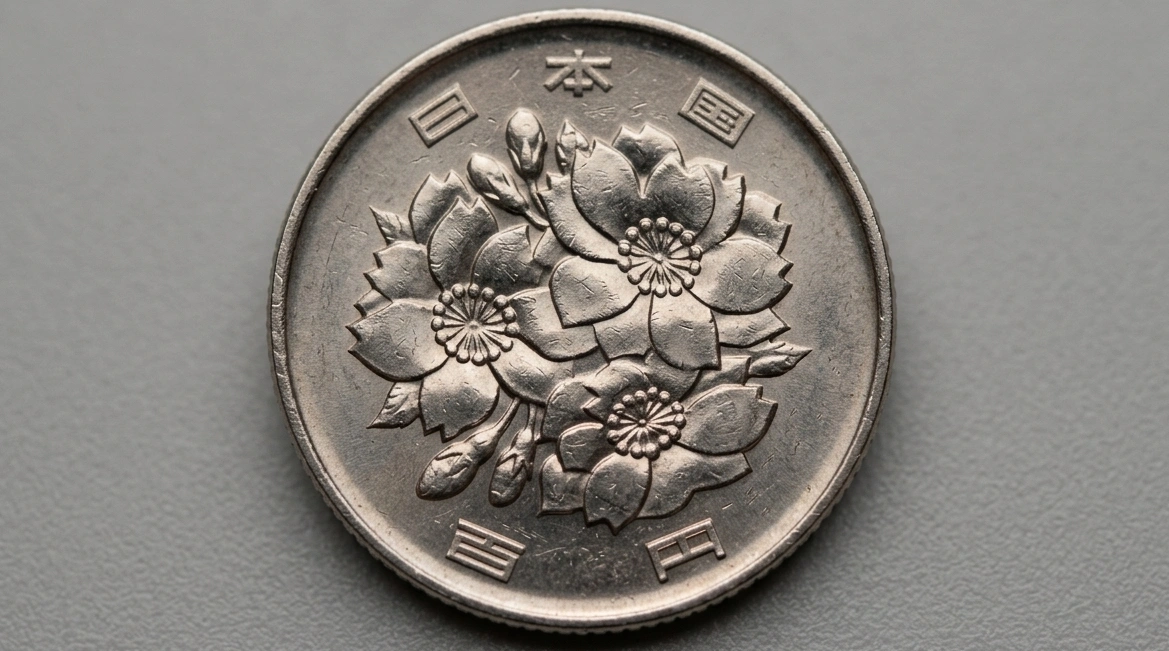
Obverse Design | Cherry Blossoms (Sakura) |
Adhering to the 4.80-gram mass remains essential for the correct operation of electromagnetic sensors in payment terminals.
Using a Copper and Nickel blend provides high wear resistance during intensive circulation.
Counterfeiting levels for this denomination stay minimal in 2026 due to the difficulty of mimicking the magnetic properties of the authentic alloy.
Chronology of Metal Composition Changes
History of the 100 Yen piece includes three technological stages defining current market value.
Showa Period Silver Issues (Phoenix type) 1957–1958
Contains 60% Silver with a mass of 4.80 grams. Limited mintage series.
Showa Period Silver Issues (Rice type) 1959–1966
Retains 60% Silver in the composition. Mass production period prior to the transition to base metals.
Copper-Nickel Issues from 1967 to Present
Complete removal of Silver from circulation coins. Implementation of the current Sakura design.
Rising global prices for Silver triggered the transition to a Copper-Nickel composition in 1967.
Market value for 1950s Silver coins in 2026 depends on metal spot prices and collector premiums.
Vending Economics and the Role of 100 Yen
Japan maintains the highest density of vending machines per capita worldwide.
Network functionality depends directly on the availability of 100 Yen coins in circulation.
Fixed price thresholds for basic goods → Stability of the denomination.
Minimal need for coin mechanism modification over 60 years → Operational efficiency.
→ Average beverage price: 130–160 ¥ → Minimum requirement: at least one 100 Yen coin per transaction → Total volume in circulation: over 10 billion units
Cash remains the choice for 65% of vending purchases in 2026 despite the rise of digital payments.
Rare Year Statistics and Auction Data
Secondary market value for 100 Yen coins varies based on the annual mintage during an Emperor's reign.
Below is the market value table for rare years in UNC condition as of April 2026.
Mint Year | Mintage Approximate | 2026 Market Price |
Showa 33 (1958) — Silver | 10,000,000 pcs | 3,200 ¥ |
Showa 36 (1961) — Silver | 15,000,000 pcs | 1,800 ¥ |
Heisei 13 (2001) | 8,000,000 pcs | 950 ¥ |
Heisei 14 (2002) | 10,000,000 pcs | 800 ¥ |
Reiwa 5 (2023) | Restricted | 450 ¥ |
Economic slowdowns and reduced cash demand caused the low mintages of 2001 and 2002.
Rare Heisei dates show a 12% annual price increase over the last five years.
Production Errors and Minting Defects
Strict quality control at the Japan Mint makes errors extremely rare.
Any deviation from the norm transforms a 100 Yen coin into a high-value lot — see it inside the coin identifier app.
Off-center strike
Occurs when the blank feeds incorrectly into the striking unit. Lot prices in 2026 range from 45,000 ¥ to 120,000 ¥.
Brockage (Incuse error)
Mirror-image repetition caused by a coin sticking to the die. Specimen values exceed 250,000 ¥.
Wrong planchet strikes
Striking the design on blanks intended for 50 Yen or 10 Yen. Confirmed authentic pieces reach auction records of 600,000 ¥.
Laser scanners on production lines make finding such defects in general circulation almost impossible.
Logistics and Storage of Mint Funds
Bank of Japan manages the distribution system for 100 Yen coins.
Coins are packaged into paper rolls containing 50 units.
→ Total roll face value: 5,000 ¥ → Mass of roll without paper: 240.00 grams → Standard box: 50 rolls (2,500 coins) → Net box mass: 12.00 kilograms
RFID tags on every box allow logistics centers to track cash movements in 2026.
Using plastic tubes for long-term storage prevents the Copper-Nickel layer from darkening over time.
Price Dynamics for Silver 100 Yen Coins
Silver issues from 1957–1966 serve as investment vehicles for precious metals.
Market value evolution for the "Rice" type (1959–1966) between 2022 and 2026:
2022: 650 ¥ ↓ 2024: 820 ¥ ↓ 2026: 1,150 ¥
Global Silver market rallies drive the 18% average annual price growth.
Pure Silver mass in one coin totals 2.88 grams.
Impact of the Reiwa Era on the Market
Changing the reign era in 2019 introduced coins with the Reiwa inscription.
Early years of the new Emperor (Reiwa 1 and 2) show consistent collector demand.
Proof sets from Reiwa Year 1 are valued at 15,000 ¥ in April 2026.
Reiwa coins now represent 28% of the total volume in circulation.
Steady removal of older Showa coins increases their long-term numismatic value.
Comparison Metric | 100 Yen (Nickel blend) | 10 Yen (Bronze) | 1 Yen (Aluminum) |
Circulation Life | 30 years | 20 years | 15 years |
Corrosion Resistance | High | Medium | Low |
Relief Preservation | Excellent | Medium | Weak |
Hardness of the alloy ensures that Sakura blossom details remain visible even after decades of use.
Bank of Japan removes heavily worn coins for melting and recycling into new mintages.
Authentication and Anti-Counterfeiting Measures
Unlike the hidden holograms on the 500 Yen coin, the 100 Yen piece relies on micro-relief for security.
Verification methods in 2026:
Visual inspection of the sharpness of the Sakura stamens.
Checking the acoustic resonance when dropped on a hard surface.
Measuring alloy conductivity in automated detectors.
Monitoring the vertical alignment of the edge reeds.
Cast counterfeits often leave a characteristic porosity on the coin's fields.
Professional numismatists utilize a free coin identifier and value app to identify authentic striking marks.